Top 10 Benefits of Brown Kraft Box Packaging for Modern Businesses

Packaging is no longer simply a protective layer around a product. For modern retailers, bakeries, food businesses, cosmetics brands, and e-commerce sellers, packaging can influence how customers perceive quality, sustainability, and attention to detail. Among the many packaging formats available today, brown kraft packaging has become particularly useful because it combines a natural appearance with practical functionality.
Brown Kraft Box Packaging is especially suited to brands that want a simple, recognisable presentation without relying on excessive graphics or plastic-based materials. When paired with a viewing window, kraft packaging can also allow customers to see the product before opening the box. This combination is valuable in retail environments where appearance and product visibility can affect purchasing decisions.

Why Kraft Packaging Remains Relevant
Kraft paper is widely recognised for its natural brown appearance and paper-based construction. Its visual character can communicate simplicity, authenticity, and a connection with traditional materials. These qualities have become increasingly relevant as businesses consider how packaging choices fit into broader brand and sustainability strategies.
The popularity of kraft packaging is also connected to changing consumer expectations. Shoppers are increasingly interested in packaging that feels practical rather than unnecessarily elaborate. A clean kraft box can provide a restrained presentation while still offering opportunities for branding through labels, stamps, sleeves, stickers, or printed artwork.
For small and medium-sized businesses, this flexibility is particularly useful. A single packaging style can potentially serve different product ranges while maintaining a consistent visual identity.
The Practical Benefits of Kraft Window Boxes
One of the most useful developments in paper-based packaging is the addition of a transparent viewing panel. Kraft Window Boxes combine the structural benefits of a paperboard box with direct product visibility.

A window can be particularly helpful when the product itself contributes to its visual appeal. Bakery products, handmade goods, confectionery, candles, soaps, gifts, and selected retail products can benefit from packaging that allows customers to inspect the contents without opening the box.
There are several practical advantages:
- Product visibility: Customers can see the colour, shape, arrangement, or finish of the product.
- Presentation: A window can make carefully arranged products more visually appealing.
- Convenience: Retail staff and customers can identify contents quickly.
- Brand communication: Printed kraft surfaces can still carry logos, product information, and design elements.
- Versatility: Different box dimensions and window configurations can accommodate a wide range of products.
A kraft box with window can therefore serve both a protective and presentation function. The key is to select the right board thickness, dimensions, closure style, and window material according to the product being packaged.
Choosing Kraft Paper Window Boxes for Different Products
Packaging should always be selected around the product rather than the other way around. Weight, shape, fragility, moisture exposure, storage conditions, and transportation requirements can all influence the appropriate box specification.
For example, lightweight bakery products may require a different construction from heavier retail goods. Similarly, a product intended for postal delivery may need stronger board and additional internal protection than an item placed directly on a shop shelf.

Businesses evaluating kraft paper window boxes should consider several factors before finalising a packaging design:
1. Product Dimensions
Accurate measurements reduce unnecessary internal movement and help create a more professional presentation. A box that is too large may require additional filling, while one that is too small can compromise the product or make packing difficult.
2. Board Strength
The material should provide sufficient rigidity for the product and distribution environment. Packaging intended for shipping generally faces greater handling demands than packaging used only for local retail display.
3. Window Placement
The position and size of the window should support product visibility without weakening the structural integrity of the box. A well-positioned window can highlight the most attractive part of the product.
4. Closure and Assembly
Easy-to-assemble packaging can reduce packing time. Tuck-end, auto-lock, sleeve-style, and other constructions may be appropriate depending on the application.
5. Printing and Finishing
Kraft surfaces can support minimalist branding, typography, logos, product information, and selected decorative elements. The objective should be readability and consistency rather than excessive decoration.
Kraft Bakery Boxes With Window: A Strong Retail Application
The bakery sector provides one of the clearest examples of how packaging can combine functionality and presentation. Kraft bakery boxes with window can display cakes, pastries, biscuits, cupcakes, brownies, doughnuts, and other visually appealing products while providing a structured enclosure.
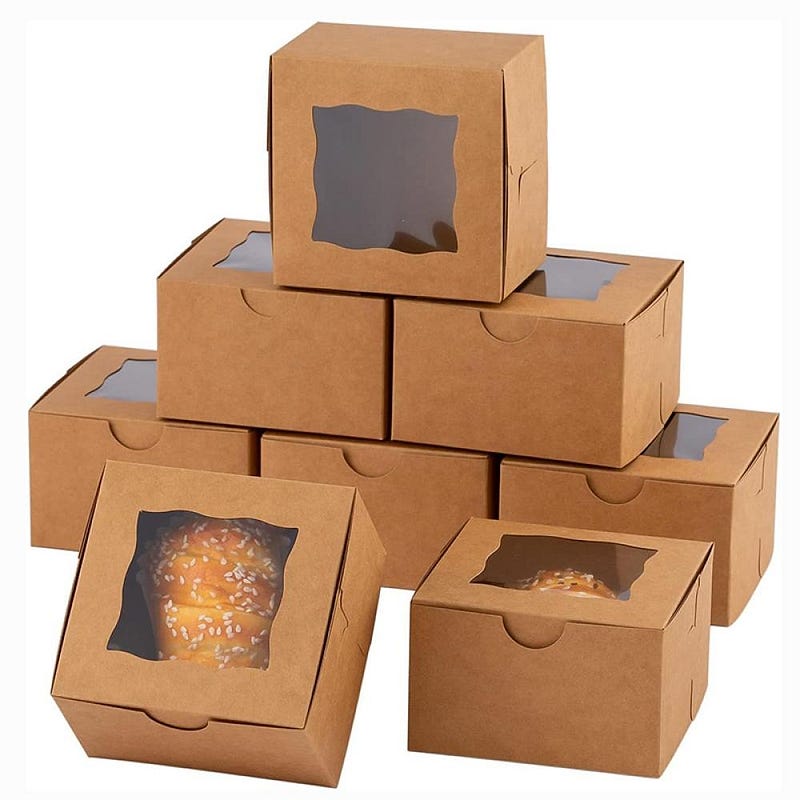
For bakeries and independent food businesses, presentation can be particularly important. Customers often make quick purchasing decisions based on how fresh and appealing a product appears. A viewing window helps communicate that visual information before the package is opened.
However, food packaging also requires careful consideration of hygiene, food-contact suitability, ventilation where necessary, and protection against crushing or contamination. The box design should therefore be selected according to the specific food application and applicable packaging requirements.
For businesses that sell baked goods online, the challenge becomes more complex. Packaging needs to look attractive while also protecting the contents during transportation. This makes structural design, product fit, and appropriate internal protection just as important as visual presentation.
Common Challenges and How to Address Them
Although kraft packaging offers many advantages, it is not automatically suitable for every application. Businesses should assess potential problems before placing a large packaging order.
Challenge: Product movement inside the box
A poorly fitted box can allow products to shift during handling.
Solution: Match the internal dimensions closely to the product and consider suitable inserts where necessary.
Challenge: Weakness during transportation
Long-distance delivery can expose packaging to compression, moisture, and repeated handling.

Solution: Choose an appropriate board grade and consider secondary protective packaging for fragile products.
Challenge: Limited branding visibility
The natural kraft surface may not suit brands requiring highly colourful or photographic designs.
Solution: Use selective printing, labels, sleeves, or contrasting typography to create a distinctive identity without losing the natural aesthetic.
Challenge: Window durability
The transparent section can become a weak point if poorly integrated into the box.
Solution: Consider window size, placement, material, and construction during the design stage.
These considerations demonstrate why packaging should be approached as a product-development decision rather than simply a printing exercise.
Current Packaging Trends and Design Considerations
Packaging trends continue to move toward practical, visually clear, and environmentally conscious designs. This does not mean every business needs to adopt the same style. Instead, successful packaging tends to reflect the product, audience, distribution model, and brand identity.
Minimalist packaging is one example. Natural colours, simple typography, restrained graphics, and visible materials can create a clean appearance without overwhelming the product.
Another important trend is the growing emphasis on material efficiency. Using appropriately sized packaging can reduce unnecessary material consumption and may also improve storage and shipping efficiency.

Personalisation is also becoming more accessible. Smaller businesses can use custom printed boxes, branded stickers, stamps, and labels to create a distinctive presentation without requiring extremely complicated packaging structures.
For businesses researching packaging options in the UK, resources such as The Quantum Print’s brown kraft box packaging range can provide a useful reference point when considering box styles, printing possibilities, and windowed packaging formats.
How to Create More Effective Kraft Packaging
The most effective packaging starts with the customer experience. Before choosing a design, businesses should ask:
- What does the customer need to see?
- How will the package be transported and stored?
- Does the box protect the product adequately?
- Is important product information easy to read?
- Does the packaging match the brand’s visual identity?
- Can the design minimise unnecessary material?
- Is the packaging practical for staff to assemble and customers to handle?
Testing is another important step. A prototype can reveal issues with dimensions, assembly, window positioning, product movement, and structural strength before a larger production run.
Businesses should also consider how packaging performs throughout its entire journey — from manufacturing and storage to delivery, retail display, opening, and disposal. This broader perspective can help identify improvements that are not immediately obvious from the appearance of the box alone.
Final Thoughts
Brown kraft packaging demonstrates how relatively simple materials can support modern retail and e-commerce requirements. Its natural appearance, adaptability, printable surface, and compatibility with windowed designs make it relevant across food, bakery, gifting, cosmetics, handmade products, and other retail categories.
Whether selecting a brown kraft box with window for product visibility or a conventional kraft carton for shipping, the most important consideration is balance. Packaging should protect the product, support efficient handling, communicate useful information, and create an appropriate customer experience.
For businesses exploring Brown Kraft Box Packaging, the strongest approach is not simply to follow a trend. Instead, evaluate the product, audience, transportation requirements, branding objectives, and material considerations together. When those elements are aligned, kraft packaging can become a practical part of a thoughtful and effective packaging strategy.
Read More :
Top 10 Essential Oil Packaging Ideas for Modern Brands
Top 10 Soap Packaging Boxes Ideas for Modern Brands
Top 10 Chocolate Box Packaging Trends Every UK Retailer Should Know


Comments
Post a Comment